Do Venues Need a Music License for Live Bands? PROs Explained
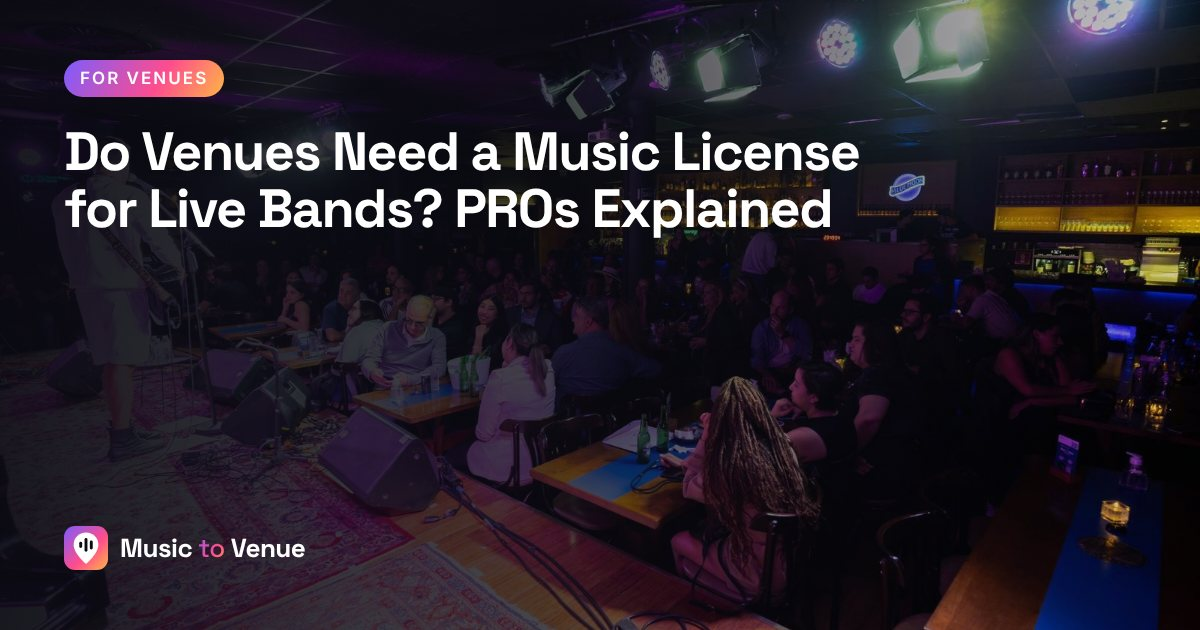
In most cases, yes. If a band or DJ performs copyrighted songs at your bar, restaurant, brewery or club, the venue generally needs public performance licenses, and that responsibility usually falls on the business, not the performer. In the US those licenses come from four performing rights organizations (PROs): ASCAP, BMI, SESAC and GMR. This is general information, not legal advice, so confirm your situation with a qualified attorney or the PROs directly.
What a public performance license covers
US copyright law gives songwriters and publishers the right to control public performances of their songs. When music is played in a business open to the public, that counts as a public performance, whether it comes from a live band, a DJ or a speaker system.
PROs represent songwriters and publishers, collect license fees from businesses, and pay royalties to their members. A license from a PRO lets you host performances of any song in that PRO’s catalog without tracking down each songwriter.
The license covers the composition (the song itself). It is the venue that holds it, because the venue is the business presenting the performance to the public. A band playing covers at your place does not usually bring its own license.
The four US PROs
| PRO | Founded | How it works |
|---|---|---|
| ASCAP | 1914 | Large catalog, open membership, operates under a federal consent decree |
| BMI | 1939 | Large catalog, open membership, operates under a federal consent decree |
| SESAC | 1930 | Smaller, for profit, membership by invitation, not under the same consent decrees |
| GMR (Global Music Rights) | 2013 | Smallest, invitation only, represents a select group of high profile songwriters |
Each PRO licenses only the songs it represents. A license from ASCAP does not cover songs that are only in BMI’s catalog, and so on. Since cover bands pull from all over, many venues that host live music hold licenses from more than one PRO.
Who needs a license
You likely need licensing if your business does any of the following with copyrighted songs:
- Hosts live bands or solo artists who play covers
- Hosts DJs
- Runs karaoke or open mic nights
- Plays recorded music as background in a space open to the public
What about original music?
If an artist plays only songs they wrote, the picture changes, but not as much as you might think. Many working songwriters are members of a PRO, which means their originals are in that PRO’s catalog. Truly all original nights from unaffiliated writers are uncommon, and most bands mix in covers anyway.
What about the small business exemption?
Federal law includes an exemption that lets some smaller businesses play radio or TV broadcasts without a license if they meet size and equipment limits (17 U.S.C. Section 110(5)). That exemption is about transmissions of radio and TV. It does not cover live bands, DJs or playlists you stream from a personal account.
What drives the cost
Each PRO sets its own rate schedule, and fees change over time, so get current quotes directly from each one. Common factors include:
- Venue capacity or occupancy
- Whether music is live, recorded or both
- How many nights per week you have live music
- Whether you charge a cover or admission
- The type of business (bar, restaurant, hotel, nightclub)
Ask each PRO how it defines your venue type and capacity, since a small change in category can change the rate. Keep notes on who you spoke with and when.
For a typical small venue, each license is an annual fee. Build it into your music budget the same way you plan artist fees and sound.
The risk of skipping it
PROs do send representatives to venues, check event listings, and contact businesses they believe are hosting unlicensed music. If a dispute ends up in court, US copyright law allows statutory damages of $750 to $30,000 per work infringed, and up to $150,000 per work for willful infringement, plus possible legal fees. A single night of covers includes many songs, so exposure can add up quickly.
Background music counts too. Streaming a personal playlist through a consumer music app in your dining room is generally not licensed for business use. Many venues use a commercial background music service that bundles the needed rights, then hold PRO licenses for live nights.
Licensing is almost always cheaper than a lawsuit. If a PRO contacts you, do not ignore it. Respond, ask questions, and get advice if needed.
How to get licensed
- List how you use music: live, DJ, karaoke, background, and how often.
- Note your capacity and whether you charge a cover.
- Contact each PRO or use its online licensing portal for a quote.
- Keep copies of your licenses and renewal dates in one place.
- Review each year as your music program grows.
The Texas Governor’s office publishes a clear overview of music in venues and licensing basics that is useful reading for venues in any state.
What artists should know
Artists generally are not the ones who buy these licenses for a venue. Still, it helps to understand the system. If you write songs, joining a PRO is how you get paid when your music is performed publicly. Ask your PRO how to report your live set lists so your originals earn royalties.
How Music to Venue fits in
Music to Venue is a booking marketplace in early access for Las Vegas and Salt Lake City. It helps venues find and book bands, solo artists and DJs that fit their room. It does not provide music licenses, so venues should handle PRO licensing on their own. See how it works or read more on the venues page.
Ready to plan your music nights with the paperwork handled? Join free during early access and start booking artists that fit your venue.
FAQ
Does the band or the venue pay for the music license?
Usually the venue. The business presenting the performance to the public is generally responsible for public performance licenses.
Is one PRO license enough?
Usually not for live music. Each PRO only covers songs in its own catalog, and cover bands play songs from many catalogs.
Do I need a license if bands only play original songs?
Maybe. If the songwriters belong to a PRO, their originals are in that PRO’s catalog, so a license may still be needed.
Is this legal advice?
No. This is general information. Contact the PROs directly or a qualified attorney about your specific venue.
Book live music without the back and forth
Music to Venue connects bands, solo artists and DJs with venues in Las Vegas and Salt Lake City. Free to join. Artists keep 100% of their fee.
Keep reading
 Venues How AI Matching Is Changing the Way Venues Book Live Music
AI matching turns a plain language description of your night into a ranked shortlist of artists. Here is how it works and where human judgment still matters.
Oct 30, 2026
 Venues Acoustic Music for Wineries, Patios and Brunch: A Booking Guide
Solo acts and duos are the easiest way to add live music to brunch, patios and tasting rooms. Here is how to book the right one.
Oct 29, 2026
 Venues What to Do When a Band Cancels Last Minute
A last minute cancellation does not have to ruin the night. Build a backup list, write a fair policy and know your plan B before you need it.
Oct 28, 2026